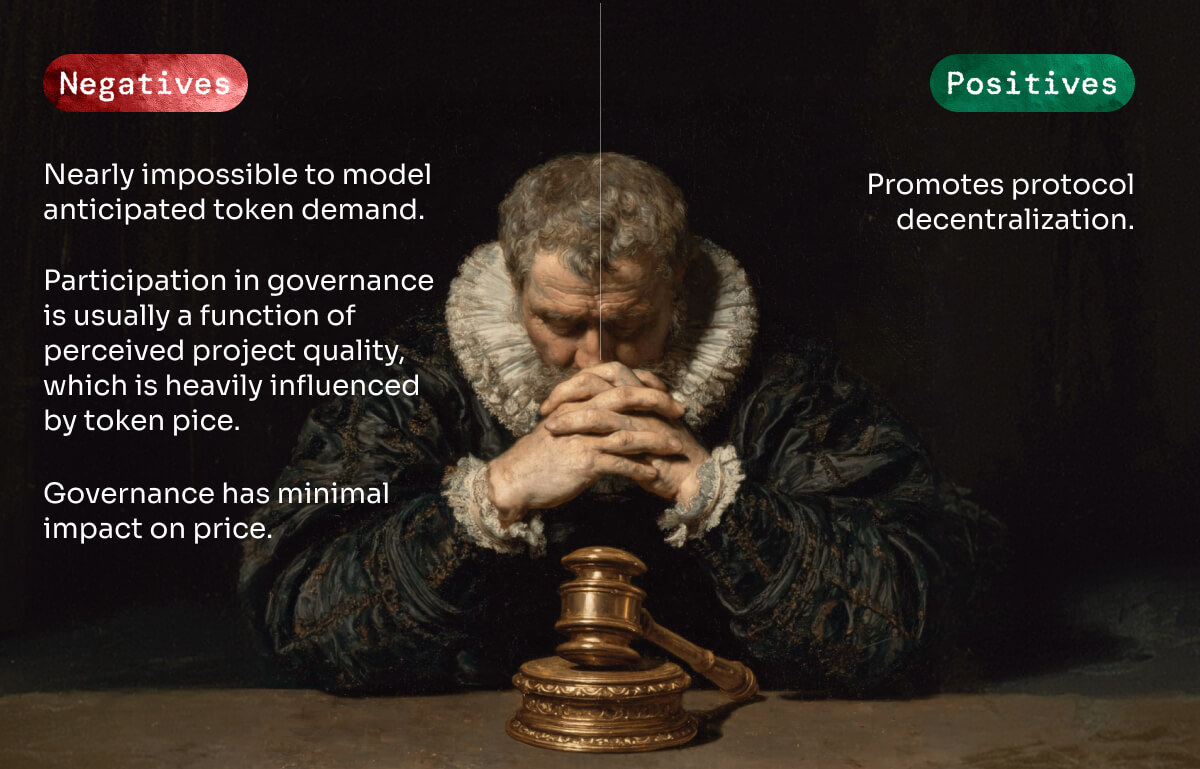
Governance is often listed as a first-order utility, "hold our token to vote on protocol decisions." But when evaluated as a demand driver (does governance motivate people to buy the token?), the evidence is weak.
Why governance fails as a demand driver: To estimate governance-driven demand, you would need to select comparable projects and estimate participation rates (which typically range from low single digits to ~10% across major protocols), estimate proposal frequency, and model drop-off rates when no active proposal is live. Every step introduces rough approximations that significantly impact the output. The result, medium complexity to model, very low accuracy, effectively a shot in the dark.
The deeper problem is circular dependency. Governance participation is heavily influenced by token price, when price is strong, holders engage; when price declines, they exit. Governance follows price rather than driving it. On the Price Impact vs Estimability matrix, governance sits in the bottom-left quadrant, the weakest position.
What governance is actually good for; decentralization narrative (important for regulatory positioning and community trust), large-holder alignment (whales accumulating for governance influence tend to be long-term holders, adding stability), and protocol legitimacy (an active governance process signals operational maturity to exchanges and institutional partners).
Include governance in your token design for credibility and engagement. But do not model it as a meaningful contributor to buy-side pressure. If your demand model relies on governance to fill a gap, that gap is still open.