Most projects treat demand as an article of faith, "if we build it, they will come." Forgd takes a different approach; approximate the dollar value of expected demand by source, even when precision is impossible. A rough estimate grounded in methodology is vastly more useful than no estimate at all.
Each demand origination type requires a different estimation methodology:
| Demand Origination | Methodology | Accuracy | Reasoning |
|---|---|---|---|
| Native ("Utilities") | Comparable project analysis, governance participation rates, feature adoption from similar protocols. | Low | Usage depends on product adoption, which is inherently uncertain pre-launch. |
| Synthetic ("Mechanisms") | Market-impact analysis, estimate $ allocated to buybacks/burns, simulate frequency and magnitude. | Medium | Dollar amounts can be modeled, but price response is harder to predict. |
| Partnerships & Institutional | Quantify expected USD inflows from B2B arrangements (OTC commitments, treasury mandates, fund accumulation). | High | Contractual commitments = known dollar amounts with defined timelines. |
| Speculation | Benchmark via comparables, early-stage volume and price performance of similar launches. | Low | Speculative behavior is driven by narrative and market conditions, both unpredictable. |
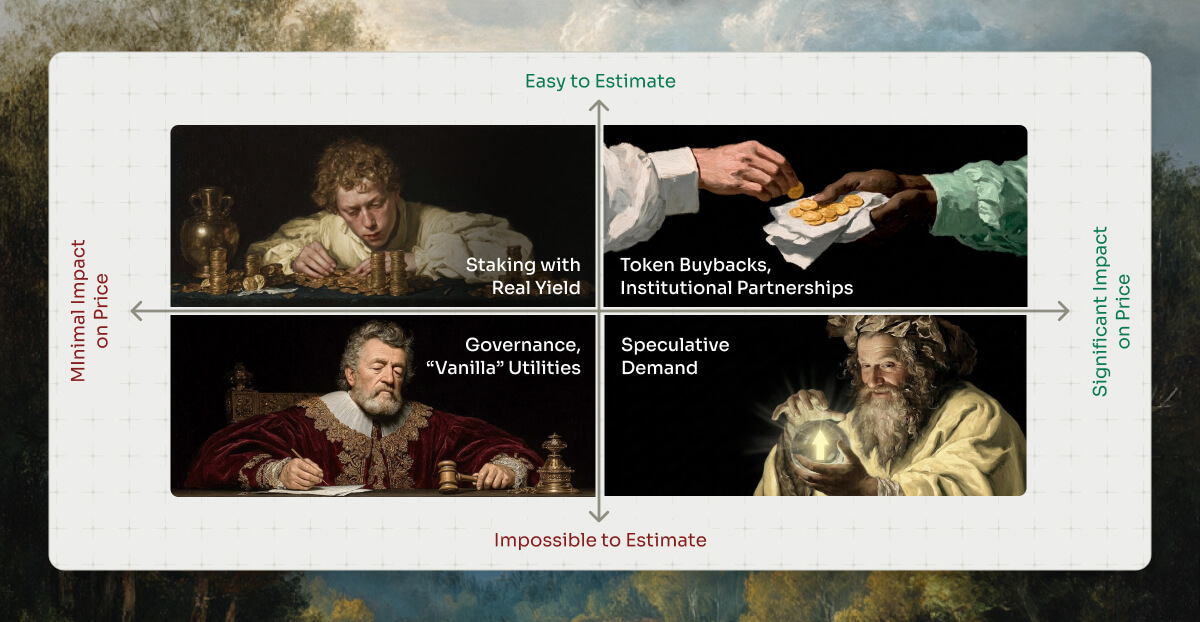
The key synthesis: Price Impact vs Ability to Estimate
Not all demand drivers are created equal. When plotted on a matrix of "how much does this actually move the price" against "how accurately can I estimate it before launch," a clear hierarchy emerges:
- Top-right (best position): Institutional Partnerships, high price impact, high estimability. This is why Forgd emphasizes OTC structures and B2B demand.
- Top-left (predictable but modest): Staking with Real Yield, easy to estimate because yield rates and participation can be benchmarked from comparable projects, but minimal direct price impact since staking removes tokens from circulation gradually rather than creating aggressive buy-side pressure.
- Center: Token Buybacks, moderate impact, moderate estimability. Useful but dependent on revenue projections.
- Bottom-left (weakest): Governance, basic utilities, low price impact, nearly impossible to estimate. Include these for protocol credibility, not as price levers.
- Bottom-right (wildcards): Speculative demand, potentially high impact, essentially impossible to estimate. Plan for it, but don't build your model around it.
The actionable takeaway is to prioritize demand drivers that are both impactful and estimable. Build your demand model around institutional partnerships and mechanism-driven flows where you can quantify inputs, then layer in utility and speculation as upside scenarios.
Book a Tokenomics Consultation with Forgd to model your project's demand drivers.