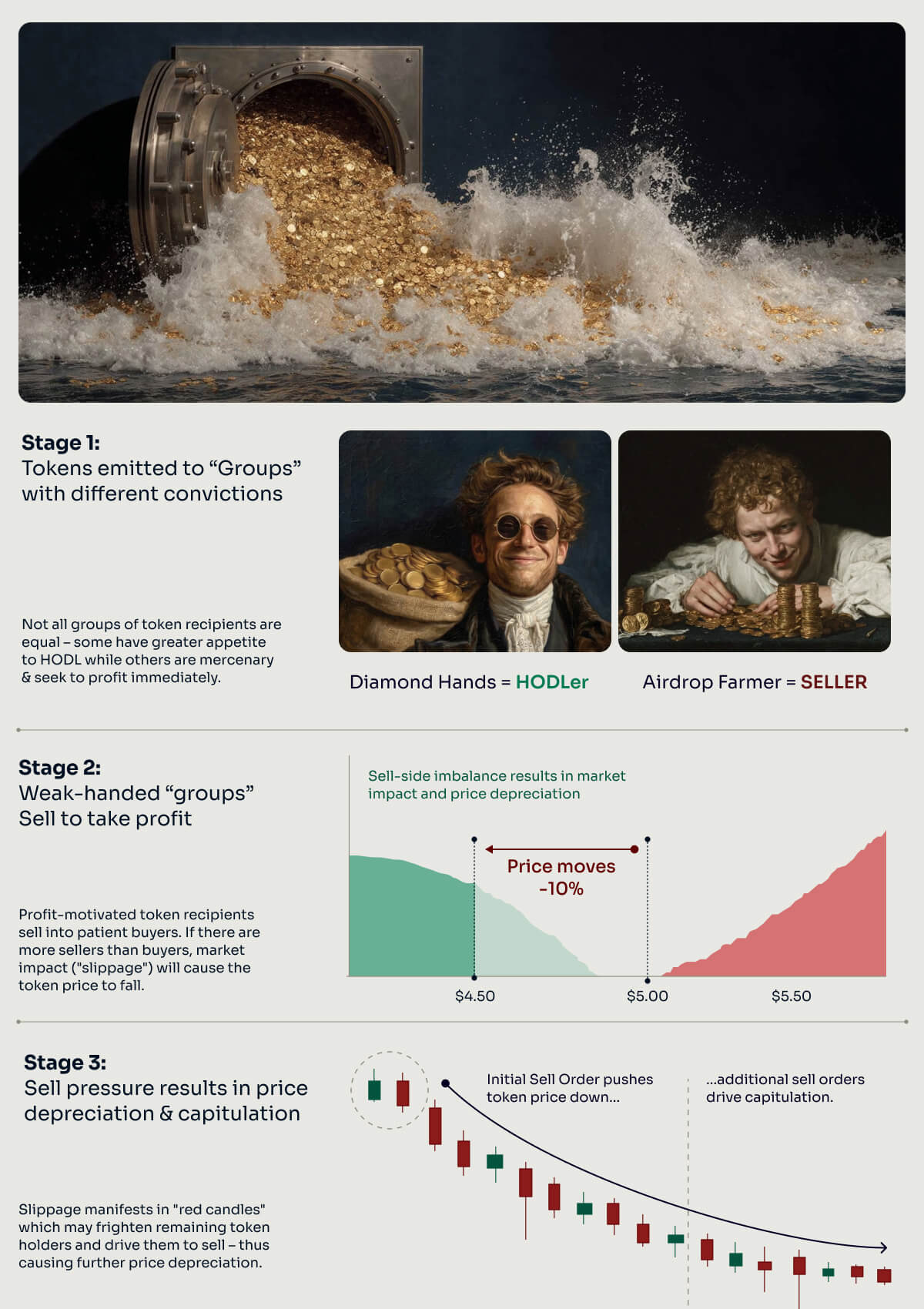
Because not all token recipients behave the same way. A 1,000,000 token unlock to your treasury has fundamentally different market impact than a 1,000,000 token airdrop to retail participants.
The quantity of tokens entering circulation matters, but who receives them and what their liquidation behavior looks like is what actually determines price impact.
The sell pressure cascade:
| Stage | What Happens |
|---|---|
| 1. Tokens reach groups with different conviction levels | Different recipients have fundamentally different holding convictions. Long-term aligned holders behave completely differently from short-term profit-motivated recipients. The same token quantity creates vastly different sell pressure depending on who receives it. |
| 2. Low-conviction recipients sell to take profit | Profit-motivated recipients sell into patient buyers. If the volume of sellers exceeds available buy-side liquidity, the excess sell pressure causes slippage and price decline. |
| 3. Sell pressure triggers further selling | Price decline from Stage 2 frightens remaining holders who were undecided, creating a cascade of further selling. The initial sell pressure amplifies. |
Sell pressure by recipient group:
| Group | Typical Lock-Up | Sell Pressure | Price impact | Key Considerations |
|---|---|---|---|---|
| Airdrop recipients | 0 months | Aggressive | Aggressive | The majority of recipients sell upon receipt. Valuable for decentralization narrative but carries significant price risk. Size carefully. |
| Exchange integration fees | 0 months | Aggressive | Aggressive | Nearly all tokens allocated to exchanges for integration and marketing will be aggressively sold within the first week post-TGE. Treat these as a cost of listing, not a partnership investment. |
| Private sale investors | 12 months | Moderate | Moderate | Institutional investors are rational actors. Most will liquidate via TWAP (Time-Weighted Average Price) execution to minimize market impact, selling steadily over days or weeks rather than dumping. |
| Team and core contributors | 12 months | Moderate | Conservative | Token allocations represent compensation. Team members typically have stronger project alignment and sell more gradually. Market impact is lower than financial investors. |
| Treasury and ecosystem fund | 3 months | Conservative | Conservative | Commonly used as phantom float. Minimal sell pressure unless treasury converts to stablecoins for operational expenses, and even then, TWAP or OTC execution is standard. |
The critical takeaway is that when designing your token allocation and emission schedule, do not just model how many tokens unlock at each point in time. Model who receives them and what their likely selling behavior is. Aggressive sellers (airdrops, exchange integration fees) should be concentrated at TGE, when speculative demand and retail buy-side pressure are at their strongest and can absorb the selling. Allowing these groups to unlock later, after initial momentum has faded, means weaker buy-side conditions absorbing the same sell pressure, which amplifies price impact.
Book a Tokenomics Consultation with Forgd to model sell pressure by recipient group and optimize your emission schedule accordingly.